



UI/UX design services

UI/UX Design

Transforming digital experiences with immersive and user-centric design to redefine engagement, empower brands, and unlock growth opportunities.

Explore our work

Why Choose Us?

Industry-Leading Design Expertise icon

Industry-Leading Design Expertise

We pioneer innovative solutions by integrating the latest design trends and technologies, ensuring your brand stands out with intuitive interfaces.

Exceptional User Experience icon

Exceptional User Experience

We specialize in designing interfaces that engage and retain users effectively, leveraging advanced UX methodologies and design principles.

Tailor-Made Solutions icon

Tailor-Made Solutions

We provide customized design solutions tailored to address specific objectives and challenges, ensuring optimal user engagement and satisfaction for each business.

Data-Driven Design icon

Data-Driven Design

Our design decisions are informed by thorough analysis of user data and feedback, ensuring a user-centric approach that optimizes usability, functionality, and overall user experience.

Collaborative Partnership icon

Collaborative Partnership

We build solid collaborations with clients, ensuring alignment with your vision and fostering transparency throughout the design process.

Measurable Impact icon

Measurable Impact

We focus on delivering measurable outcomes and continuous enhancement, using analytics and performance metrics to optimize our design solutions for maximum impact.

Discover the Difference with Rootquotient

01

Discovery and Research

Discovery and Research

We begin by understanding your business objectives, target audience, and project requirements through in-depth research and stakeholder interviews.

02

User Persona Development

User Persona Development

Based on research insights, we create detailed user personas that embody various user segments, encapsulating their goals, preferences, and pain points.

03

Information Architecture

Information Architecture

We develop a clear information architecture that outlines the structure and flow of the user interface, ensuring intuitive navigation and content organization.

04

Wireframing and Prototyping

Wireframing and Prototyping

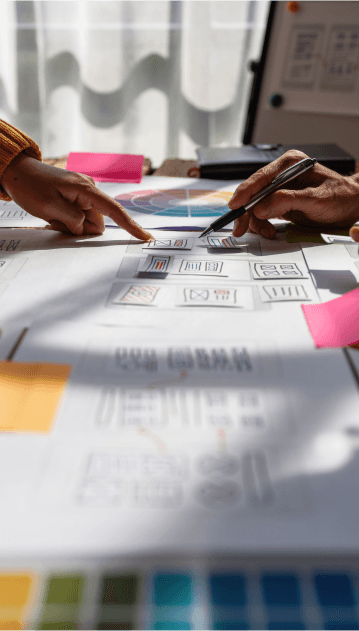
We use industry-standard tools to translate ideas into tangible wireframes and prototypes, developing low/high-fidelity versions to visualize layout, functionality, and interactions.

05

Visual Design

Visual Design

We meticulously craft visually stunning designs that reflect your brand identity and resonate with your target audience, prioritizing usability and aesthetics.

06

Usability Testing

Usability Testing

We conduct thorough usability testing with real users to gather feedback and validate design decisions. By observing interactions, we refine designs iteratively.

Delivering measurable outcomes

0 +

Product solutions delivered

0 +

Skill-gaps bridged through staff augmentation

0 +

Skilled professionals

We are confident in their abilities because they consistently listen to feedback and check in with us. Rootquotient has made us understand our product better because of their helpful recommendations.

Molly Beck

Molly Beck

CEO & Founder

Technology Solutions for Product Excellence

Backend stack 1Backend stack 2Backend stack 3
Frontend stack
Mobile stack
Database stack
Integrations 1Integrations 2
ML/AI stack
Tools 1Tools 2
Others

Ready to Build Your Product Success Story?

Stay Ahead with Industry Insights

View our insights

Your Questions, Answered (FAQs)

A structured UI/UX engagement becomes necessary when user flows expand, interfaces feel inconsistent, feature adoption slows, or teams struggle to translate business logic into intuitive experiences. Products entering new markets or onboarding new personas also require clearer interactions. A design engagement realigns workflows, defines predictable patterns, strengthens usability, and ensures that interfaces scale without creating confusion or friction for users.

Enterprise products involve multiple personas, complex tasks, and heavy data interactions. UI/UX design improves efficiency by clarifying task pathways, restructuring layouts, and reducing cognitive load. It ensures that role-specific information is organized logically, minimizing unnecessary actions and navigation loops. These improvements help teams complete tasks faster and reduce training or support needs within large organizations.

UI/UX design strengthens e-commerce workflows by clarifying the purchase path, reducing navigation friction, and ensuring information is structured logically for decision-making. It aligns product listings, filters, carts, and checkout flows with user expectations. Clear hierarchy, predictable states, and simplified forms help users complete actions with fewer interruptions, improving conversion and task completion.

A redesign is necessary when user complaints rise, workflows become fragmented, interfaces feel outdated, or product expansion introduces inconsistent patterns. Teams should also consider redesigning when analytics reveal increased drop-offs, lower activation, or unclear navigation paths. Redesigns help align the interface with current product goals and maintain clarity as the system evolves.

Usability testing validates whether users understand workflows, interpret components correctly, and complete tasks without friction. Testing reveals confusion points, behavioral patterns, and mismatches between design intent and real interactions. Insights from testing guide refinement and ensure the final interface supports predictable behavior across user segments and scenarios.

An end-to-end UI/UX engagement includes discovery research, user journey mapping, task flow definition, wireframes, interface design, usability testing, and iterative refinement based on feedback. It ensures alignment between product goals, user expectations, and technical feasibility. The process helps eliminate unnecessary complexity, reinforces interaction predictability, and supports consistent behavior across screens and devices.

Rootquotient structures SaaS design around recurring patterns, predictable interactions, and role-based behaviors. The team validates onboarding clarity, defines consistent UI components, and ensures workflows align with how users interpret system tasks. Designs are tested for edge cases, state changes, and long-term scalability. This approach helps SaaS products maintain coherence across modules as they grow.

Accessibility ensures that interfaces are usable for people with diverse abilities. It includes color contrast rules, keyboard navigation, text scaling, screen reader compatibility, and clear interaction cues. Incorporating accessibility early reduces rework and ensures products meet regulatory standards. It also strengthens usability for all users by encouraging clarity, predictable behavior, and thoughtful content structure.

Design for regulated industries requires predictable interactions, clear data hierarchy, error prevention, and compliance with privacy rules. UI/UX decisions must reduce risk by guiding users through critical tasks, avoiding ambiguous flows, and supporting auditability. Rootquotient ensures interfaces reflect domain constraints while maintaining clarity for medical staff, financial teams, or compliance-driven workflows.

Consistency is maintained through design systems, reusable components, UI guidelines, and structured pattern libraries. These ensure visual coherence and predictable interaction behavior across modules. Rootquotient defines scalable design foundations so teams can expand features without introducing irregularities. This reduces design debt and improves coordination between design and engineering.